
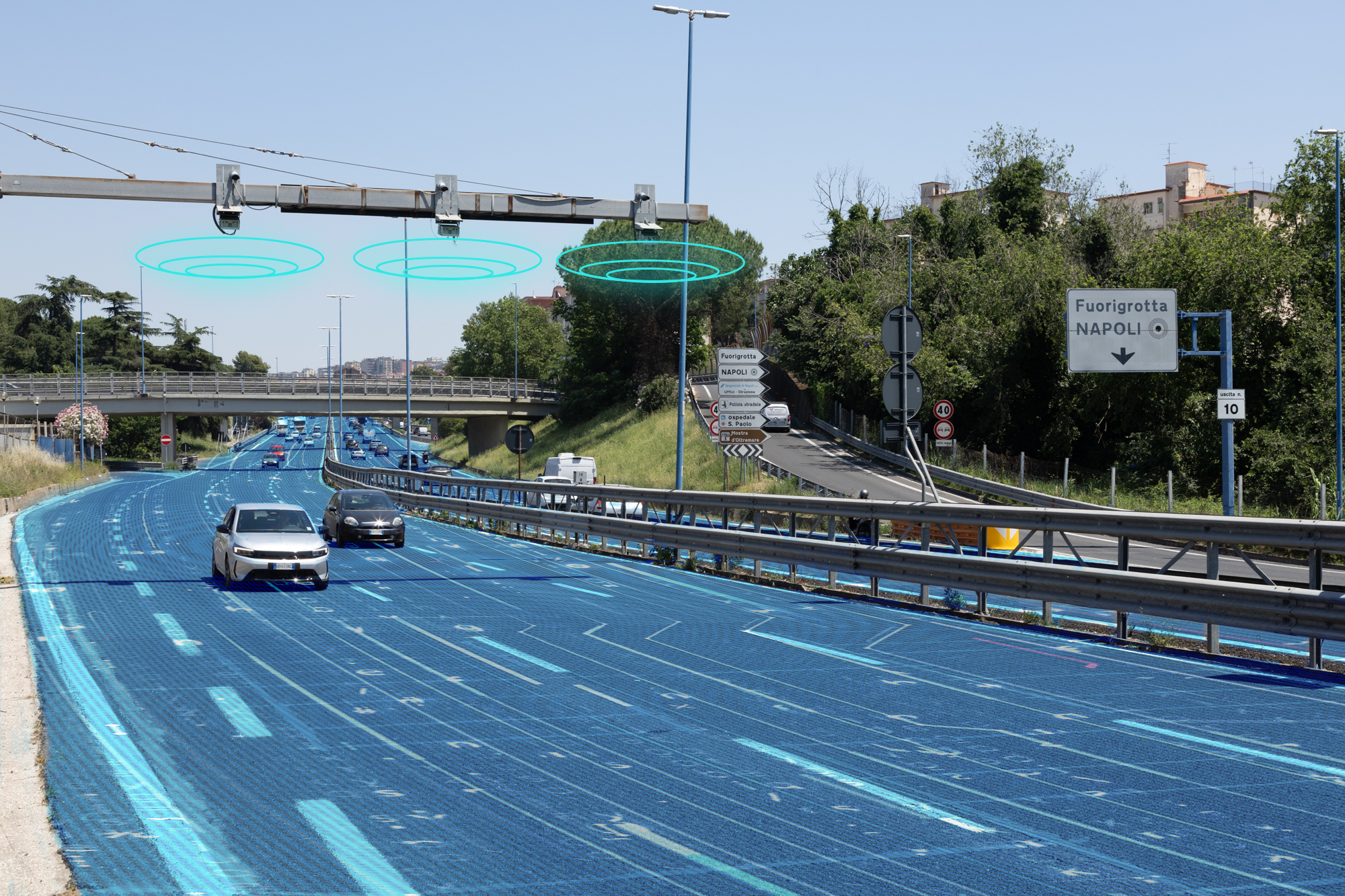
Traffic monitoring, hydrogeological risk monitoring, and vehicle-to-infrastructure communication: the three key requirements that enabled official certification by the Italian Ministry of Infrastructure and Transport (MIT)
Rome – A transportation revolution is starting in Southern Italy. Tangenziale di Napoli has entered the history of Italian mobility: it is officially the first Smart Road in the country, having obtained certification from the Italian Ministry of Infrastructure and Transport in compliance with the requirements of Ministerial Decree 70/2018. This recognition certifies its compliance with the technological standards required for the digitalisation of asset monitoring, intelligent traffic management and real-time communication with connected and autonomous vehicles.
The project, involving Tangenziale di Napoli, a company of the Autostrade per l’Italia Group, the MIT and the Centro Nazionale per la Mobilità Sostenibile (MOST), with the technological support of Movyon, the innovation hub of the ASPI Group, has transformed one of the country’s main urban road corridors into a true laboratory for smart mobility.
These are the three features that define a Smart Road according to the regulations.
Traffic monitoring: sensors distributed across the entire network collect traffic data. These data are gathered, processed and correlated by the traffic model, which generates useful information for control centre operators, supporting them in decision-making processes related to active mobility management.
Weather and hydrogeological monitoring: multiple sensors collect meteorological data, pavement condition data, water level measurements and, more generally, information on the condition of the territory surrounding the road infrastructure. The objective is to monitor in real time the conditions that could soon lead to events such as floods, landslides and other critical situations, and to alert operators whenever predefined thresholds are exceeded.
Traveller information and connected mobility: thanks to technologies enabling bidirectional communication between vehicles and infrastructure, all the information collected through the systems described above can be provided directly to travellers via an onboard vehicle interface (recommended speed, accidents, weather conditions, pavement conditions, hazards and obstacles, etc.).
It is not only the infrastructure that provides information to vehicles; the opposite is also true. For this reason, Vehicle-to-Infrastructure (V2I) communication also keeps motorway operators updated on traffic conditions in a much more precise and timely manner. Operators therefore become orchestrators of mobility, able to manage traffic proactively rather than simply reactively. Tangenziale di Napoli currently has 30 connected vehicles capable of communicating directly with the roadway infrastructure.
Today, Tangenziale di Napoli is an example of technological excellence in traffic management. The Smart Road infrastructure is based on an extensive network of intelligent cameras, sensors and communication antennas capable of collecting and analysing real-time data on traffic flows, vehicle speeds, critical events and operating conditions. Along the 22-kilometre route, 217 cameras are currently being installed, together with 15 detection gantries, 8 weather monitoring stations and 40 antennas equipped with dual ITS-G5 and Cellular V2X technologies distributed along the entire route. These devices make it possible to collect traffic data and transmit them to Movyon’s central C-ITS platform, which integrates them with additional data from external sources and processes them to ensure continuous traffic monitoring and constant communication between infrastructure and users. The systems detect information such as vehicle position, direction and speed, providing motorists with up-to-date information on traffic conditions and helping to improve both safety and travel quality.
On Tangenziale di Napoli, communication services are already operational, providing connected vehicles with real-time warnings about potential hazards such as roadworks, broken-down vehicles, weather events and other critical situations. The system also suggests the optimal speed to prevent the formation of traffic congestion. One of the most significant achievements on the network was the trial carried out for the first time in Italy on the section between Vomero and Fuorigrotta. During the tests, an autonomous vehicle adapted its speed in real time according to the information provided by the infrastructure.
A leap towards the mobility of the future, where infrastructure and vehicles become part of a single connected system. Smart Road certification not only improves safety and urban traffic management but, by making Tangenziale di Napoli the first infrastructure in Italy to be officially recognised as such, also paves the way for the nationwide deployment of connected and cooperative mobility technologies.